On most degree programmes at Aarhus University, group work is a natural part of both teaching and examinations. Many students also choose to form study groups voluntarily to exchange ideas, discuss course material, and prepare together. Both long-term study groups and short-term group work can be valuable if you engage in the collaboration actively and consciously.
If group work is not mandatory in your programme, you can reflect on what would be best for you. Perhaps you have previous experience, or you are unsure whether you work best on your own, or what kinds of tasks you prefer to do alone and which you prefer to do together with others.
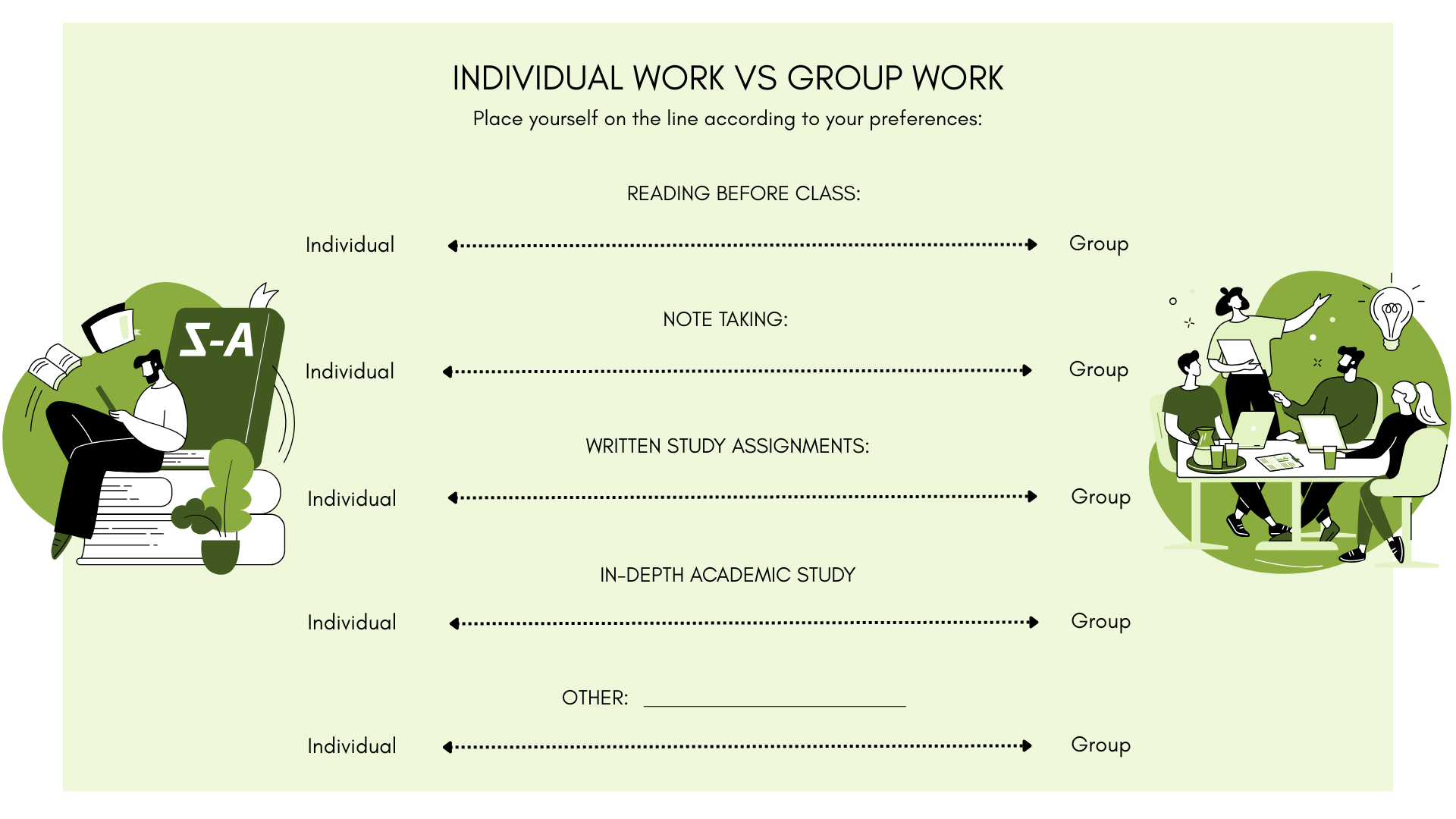
You might consider writing larger assignments together with one or more fellow students. You can help each other read through texts, discuss your choices and trade-offs, and keep each other going. Think about the pros and cons below when considering whether to write alone or with others:
Pros | Cons | |
|---|---|---|
Writing alone
| 1) Free to make decisions on the project and the writing process 2) Easier to plan with regard to your leisure activities and student job, if relevant | 1) Risk of feeling isolated and lonely during the writing process 2) More susceptible to procrastination |
Writing with others
| 1) Obligated by the collaboration and shared deadlines 2) Always someone to discuss and exchange views with - on the product as well the process | 1) Dependent on making the collaboration work 2) Need to make compromises along the way |
If you need to discuss your thoughts or get a new perspective, talk to a student counsellor.
Depending on the purpose and duration, group work can have different names, and the groups may be formed either by students themselves or by instructors:
| Type | Purpose |
| Reading Group | Discuss and understand the curriculum together |
| Writing Group | Support each other throughout the writing process |
| Project Group | Write an assignment or complete a project together |
| Peer support group | Wrok in parallel and provide feedback and guidance to one another |
| Feedback Group | Exchange drafts and give each other feedback |
| Report Group | Write a report together |
| Lab Group | Carry out laboratory work together |
Often, it seems to be taken for granted that everyone can work in groups and that it does not require any special effort. However, successful group work requires collaboration skills, as well as creating a good framework for working together from the very beginning.
Short-term group work typically arises in connection with specific assignments, presentations, or projects in teaching. The groups have a defined goal and a limited timeframe.
Examples of short-term group work: |
|---|
|
Established study groups often consist of the same people and meet regularly throughout a semester, or longer. These groups are used for preparation, discussion, and support, and the responsibility for forming them varies.
The purpose of a study group may include: |
|---|
|
There are many possibilities for what the group's work should focus on, and subsequently how you go about it. Below, you can find suggestions for different ways of working in a group:
Many students use their study group to prepare for class by discussing the texts on the syllabus. How do you go about it? How can you work on a text together in your group?
Activity | Execution |
|---|---|
Present main points
| Briefly present the most important points in the text to each other. This can initiate a discussion based on whether you have understood the text in the same way or differently. |
Divide the texts between you
| Divide the texts between you and write joint notes. Allocate one or a few texts to individuals to read in depth. Take notes or summarise your text. Just skim the texts that others in the group have read in detail. Present your notes to the other group members at your study group meeting, and discuss the texts before the lecture. Sharing your notes and summaries will give each member of the group a comprehensive overview of texts studied in the course, and this may be useful when preparing for the exam. |
Keywords on the text
| Each write down three to four keywords on the text and compare them in your group. Discuss similarities and differences between your keywords, and explain your choices. This will enable you to categorise the text or the author, and it will make it easier to compare with other texts and authors. |
Questions about the text
| Ask at least three questions for each text, and answer them in the group. You can either use the questions to discuss the text in your group, or you can use them to answer each other's questions in a shared document. This will help you clarify queries or highlight difficult issues in the material that you can then bring up in class or discuss in your group. |
Devil's advocate
| Discuss the text by dividing yourselves into defenders and devil's advocates. The role of the devil's advocate team is to attack the text by asking critical questions about it and pointing out weaknesses. The defence team is to defend the text and highlight its good points. Afterwards, everyone in the group can try to assess the text. Consult Toulmin’s model of argumentation to improve your argumentation techniques. |
Relevance of the text
| Write five lines each about how the text’ links with the course or discipline. Write a few lines about the text before the study group meeting, and discuss how each of you understand the relevance of the text in relation to the course and the subject dealt with in the text. |
Når I skal lave et mundtligt oplæg i jeres gruppe, er der nogle særlige ting, I kan overveje: |
|---|
|
Sometimes you will need to write an assignment in collaboration with others. In that situation, it is important that you discuss your expectations and ambitions regarding both the process and the final product, so that unspoken disagreements do not create conflicts along the way.
There are different ways to work together on written assignments:
Regardless of which way of working you choose, the assignment must be coherent, both in terms of content and language. When there are multiple authors, this often requires thorough editing and revision.
Remember to check your programme regulations or ask your lecturer/supervisor whether you need to indicate in the assignment who authored the different sections. If this is required, it is a good idea to be careful when dividing up the sections so that everyone’s name appears on explanatory, analytical, and discussion sections alike.
In a peer-support group, each of you writes your own assignment, but you meet regularly to discuss ideas, give feedback, and help keep each other motivated. The group is a community, not a shared project.
Advantages of a sparring group include that: |
|---|
|
Who should be in your sparring group? |
|---|
For example, you can form a sparring group with:
|
Problem-solving is a central part of many degree programmes, both during coursework and in exam preparation. It is about putting theory into practice and understanding the methods behind the solution. A study group can be a great help in this regard, but it is important that you also work through the material on your own.
| Create an overview together:
Developing a shared understanding makes it easier to see what the problems are really about and what you should focus on. |
| Choose a way of working that works: There are different ways to approach group work, and it can be beneficial to align expectations:
Regardless of the approach, it is important that you work on the problems yourself. This is where the learning happens. A useful exercise can be to make a list of typical problem types and work your way through them. You can also create templates or step-by-step methods for how to approach specific types of problems. |
| Discuss and share knowledge: Once you have worked through problems, it is beneficial to review them together:
|
In some degree programmes, memorization plays a major role. There are many concepts, definitions, names, processes, and classifications that need to be firmly committed to memory. In these cases, a study group can be an invaluable tool: you can help each other remember, understand, and review the material in different ways. Memorization is not just about repetition, but about using your memory strategically.
You can gain a lot from one another if you work actively on memorization together. Here are some well-tested methods that many students use, and that work especially well in groups:
Techniques for group-based memorisation | |
|---|---|
Concepts
| Explain concepts to each other: Explaining something to others is one of the most effective ways to understand and remember it. Use a board or whiteboard and take turns explaining concepts. You can also write the concepts in a structured chart or table to help reinforce your memory. |
Quizzes
| Quiz each other: Create short quizzes or flashcards. You might even have a rotating "quizmaster of the week", where a different group member quizzes everyone else each week. |
Summary board
| Create shared reference sheets or overview boards containing important concepts, organized by themes (for example, the nervous system or a taxonomic classification system). These can serve as quick review tools for the whole group. |
Chatbot
| Ask a chatbot quiz you on the topic: A chatbot can generate questions on your subject matter. If you're unsure about something, you can ask follow-up questions, but remember to remain critical, verify sources, and consult reliable academic literature to confirm the answers. Read more about the use of chatbots and GAI for group work here. |
Laboratory work often consists of both a practical component and a written component, typically in the form of a report. It is not merely an exercise in documenting experiments and data, but also direct preparation for larger projects such as bachelor's and master's theses. Therefore, it is a good idea to use your study group to practise the different aspects of laboratory and report work.
| Planning and preparation: Think about what needs to be ready before you get started:
|
| Collaboration and roles: While carrying out the experiment, the goal is both to work efficiently and to learn from the process. Consider:
Divide the roles among group members, and switch roles next time so that everyone gains experience with all aspects of the work. This strengthens both your collaboration and your individual skills. |
| Report writing and reflection: Developing good report-writing habits now will make it easier to write independent projects later. It is not just about submitting an assignment, but about becoming confident with the process. Consider:
A strong report is not only about good writing or impressive graphs, but also about understanding, collaboration, and the ability to document your academic work. |
If you and your study group are unable to meet in person, you can meet online. For example in Teams. In Teams, you can hold video meetings, chat and share joint documents, and it is possible to maintain conversations on a written collaboration between study-group meetings.
Some group work can benefit from discussions and talks while you are producing text. This will enable you to discuss questions, possibilities and challenges as you go along. The ‘share screen' function can be useful for this purpose.
Tips on online collaboration in your study group | |
|---|---|
 | Align expectations: It is a good idea to agree from the start how you want to use online tools, and what you expect from each other.
|
 | Be patient: Learning to use a new tool takes time, so give yourselves and each other space to become familiar with the tools. A tool should be a help in your daily study activities, so the aim is to make sure you use it correctly so it does in fact help. |
 | Consider the number of people in a chat: If a lot of people are in the chat, it can easily become "noisy" and side-tracked. But at the same time, it has the advantage that the entire group can follow the discussions and that nobody misses important information or agreements. |

There are a number of free digital services that your group can benefit from. Below is a selection of services: